
Global emissions crossed 57.1 gigatonnes of CO₂ in 2023, which constituted a 1.3 per cent rise from the previous year (UN Women Asia and the Pacific 2024). Given that the fossil fuel sector is responsible for almost 70 per cent of these emissions, its transformation has become urgent (ibid). Simultaneously, the energy sector has the potential to enable social justice and gender just policies; offer a low carbon future; create options for clean energy; ensure that the most marginalised, especially women, gain access to these clean sources of energy; and generate decent work through these transformations (UN Women Asia and the Pacific 2024, ILO 2024, Oxfam 2023). Crucially, these transformations may promote peace and strengthen social cohesion, ensuring that a shift to sustainable energy contributes to more stable, inclusive, and resilient societies.
There is a need for a reinvigorated and more urgent effort to expedite adoption of a carbon neutral economy given the current state of international politics, governance, inequitable economic policies, and uneven climate policies. Further, in the context of overwhelming dependence on oil/ fossil fuel of most countries (particularly those in the global South), and the current wars in the Gulf countries and Ukraine that have revealed the precarity of the global dependence on oil, the need to transition towards green and renewable sources of energy has become more pressing than ever. While the urgency of addressing the climate crisis and accelerating the transition to renewable energy is widely recognised, it also heightened tensions between (1) the need to move quickly and the need to ensure that the transition is just and inclusive and (2) governments and communities as tensions arise over the design and operationalisation of the transition, that could significantly alter stability and social cohesion. These concerns also raise important questions about climate inequality, power, and what ‘green’ or ‘clean’ energy entails in terms of power, labour, racial and gender implications, and the human costs of energy transition. They also highlight the need for conflict-sensitive approaches to energy transitions to ensure that such processes do not deepen existing vulnerabilities, inequalities, or sources of fragility.
In this context, this special issue aims to bring together voices and research from communities that are actively calling out the social, economic, and ecological injustices and tensions that have historically accompanied the pursuit and extraction of critical minerals, sources of nuclear energy as well as renewable sources in the global South. It aims to unpack ‘green energy’ and ‘green colonialism’, demand equal access to renewable energy, and call for equitable climate finance. Finally, and importantly, it aims to bring together experiences and case studies of women’s cooperatives, grassroots collective and other community-led initiatives in working towards a just, accountable and conflict sensitive energy transition that redistributes power, recognises care and gendered labour, promotes social cohesion, prioritises locally led solutions, and empowers local communities and economies.
Questions:
- How do we unpack the contradictions and power inequities embedded within green renewable and non-fossil/carbon energy?
- What does it signify for the local communities, especially for women and other marginalised groups?
- What do these reveal in terms of social cohesion, stability, and potential social tensions arising from energy transition processes?
- What are the feminist, decolonial, and intersectional ways in which just energy transition research, policy, and practice are being executed?
- How do these approaches contribute to more inclusive, equitable, and conflict-sensitive energy governance?
- How do or can women’s cooperatives and community-based solidarity economies generate alternative models for just energy management, energy democracy, and a just transition?
- In what ways is social reproduction and gendered labour invisibilised in the just energy transition processes?
- How can the relationship between energy poverty, care work, and women’s poverty be made visible?
- How can policies and programmes ensure these burdens be relieved/ compensated/ acknowledged/ more proportionately distributed?
- What innovative and women- / community-led strategies are successfully leading and advocating for gender-responsive, equitable, and accessible renewable energy policies at local, national, and international levels (including at the COP) and designing and monitoring programmes? Explain through case study experiences.
- What novel and effective strategies are being deployed by communities to demand equitable representation in policy discussions at multiple levels (community, national, international)? What challenges do they face in these processes?
- How can investments and climate finance be monitored to ensure that they reach those who are most vulnerable to energy poverty and those whose livelihoods have depended on the fossil fuel industry, rather than reinforcing existing wealth gaps?
- How can the transparency and accountability of climate finance mechanisms be ensured? How can the capacity of local actors, women’s groups to monitor and audit these processes be strengthened?
- How can transparency and accountability of climate finance support equitable and conflict-sensitive distributional outcomes?
- What is the role of coalitions and movements tackling ecological crisis and its impacts, and how do they contribute to strengthening just energy transitions?
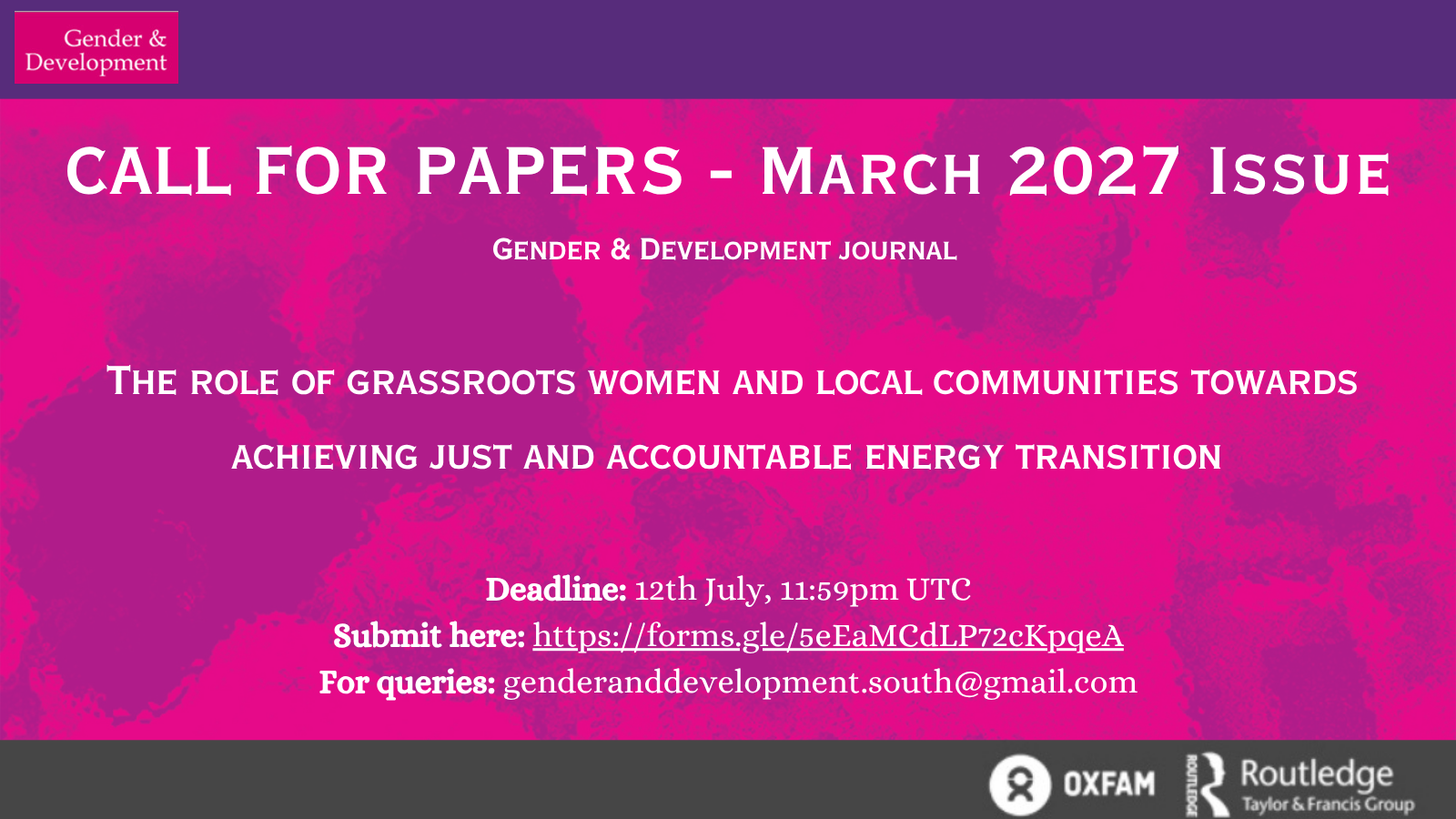
Read the detailed call here: The role of grassroots women and local communities towards achieving just and accountable energy transition
Our guest editors:
This issue will be guest edited by Eileen Wakesho, Desy Ayu Pirmasari, Gracsious Maviza, and others.
Submissions:
We invite contributions from community and grassroots leaders, civil society organisations and networks, researchers, academics, policymakers, and practitioners in the form of research articles, case studies, and essays.
Please submit an abstract of 500 words (not counting references) with details about your research and preliminary findings or a small multi-modal proposal (a two-minute video clip abstract or 500 word abstract with images) using the submission link below.
Abstract/proposal submission link: https://docs.google.com/forms/d/e/1FAIpQLSdMPKD4efVT1LuIghA-7cOzxP565_D23IwKM7i3bH0x6FL96w/viewform?usp=header
Deadline: 12 July 2026, 11:59pm UTC
Please read the Guidelines for contributors carefully before abstract/proposal submission. Please send any queries to genderanddevelopment.south@gmail.com.
Note about Gender and Development:
Gender & Development, co-published by Oxfam and Routledge/Taylor & Francis, has been a steadfast source of essential readings in the field of development for over 30 years. Since its founding in 1993, the journal has critically explored a range of cross-cutting issues in the areas of gender and development. It is a trailblazer in establishing inclusive and decolonialist approaches to knowledge creation and management in the wider international humanitarian and development sectors. While previously hosted by Oxfam Great Britain, a consortium of Oxfam affiliates in the global South – Oxfams Brazil, Colombia, India, Oxfam KEDV (Turkiye), Mexico and South Africa – has now been hosting the journal since 1st January 2022.