
Women United: Stories of Women’s Struggles for Equality in the Canadian Auto Workers Union
by Peggy Nash and Julie White, Toronto: Between the Lines, 2025
Reviewed by Riya Osti
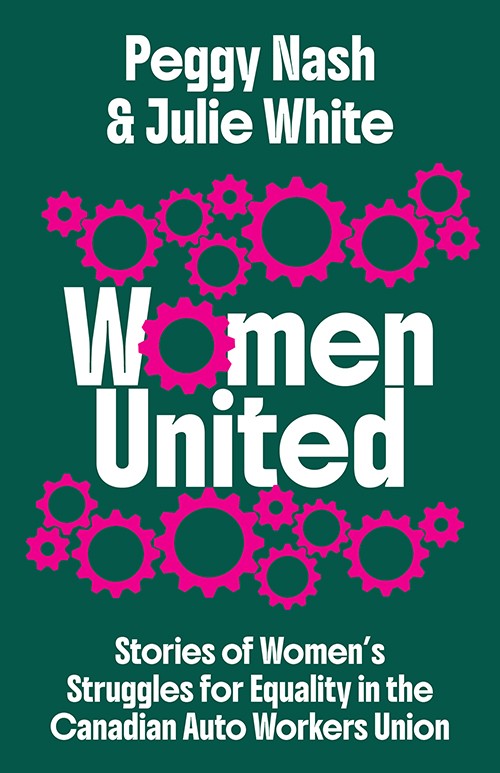 This book situates itself at the intersection of memoir and historical analysis, offering an account of feminist activism across diverse periods in Canadian history. In their own voices, Nash and White, the authors of Women United, position themselves within the very stories they tell. They weave together personal narrative and collective memory, recounting not only their own experiences but also those of the many women they worked alongside. They also highlight individual stories of women across Canada who organised and advocated, playing a significant role in establishing the foundational feminist labour rights reflected in Canadian labour practices today. In doing so, the book encourages readers to reflect on the origins of these rights, an aspect that change-makers, practitioners, and researchers often take for granted.
The authors intentionally use these stories to highlight how social capital and community relationships foster confidence among women and marginalised workers in the workplace. These relationships led to the creation of networks that helped workers gain social recognition and build mutual support among labourers. Through the story of Peggy Nash, for instance, readers learn about her efforts to secure higher wages for women airline workers and her eventual role in merging the Canadian Airline Employees Association (CALEA) with the broader network of the Canadian Auto Workers (CAW). The book frames this not simply as an institutional merger, but as a pivotal turning point in cultivating a union culture in which women felt genuinely supported and visible. It was through the establishment of women’s conferences, following this merger, that women began to understand what a politically contested group looks like and to recognise the power of collective organising. These conferences were intentional social and political spaces, created in response to concerns that women were ‘not as involved as they need to be’ (p. 72), within union decision-making processes. Through the ‘support and help of other women’ (p. 77), women gained a clearer understanding of unions, motivating them to help shape workplace rules that advance labour rights while enabling their full participation. These conferences also became critical sites for, especially, immigrant women who were less familiar with the Canadian landscape, providing opportunities to learn about workplace rights, build collective political consciousness, and develop the confidence and leadership skills necessary to advocate effectively for workers’ rights.
Building on this idea, the book engages deeply with the concept of intersectionality throughout its seven chapters by sharing the stories of immigrant women, Indigenous women, and women of colour in Canada, whose unique histories meant additional challenges in being recognised in the workplace. The authors bring these stories together through interviews, which makes the narrative feel personal and grounded in lived experience. Through each commentary and account, readers can understand the feelings, hear the concerns, and sense the pain that these women experienced while advocating for their basic workplace rights. The courage it took for these women to step out of their comfort zones, often as the only woman of colour in the room, ultimately led to the development of leadership courses specifically for women of colour, providing tools to support their success in the labour force. This journey also prompts readers to reflect on how we understand women’s historical labour and the extent to which it has shaped the diversity-focused rights present in Canada today. The book emphasises that achieving these rights was not a linear process, but rather a ‘game of snakes and ladders’ (p. 242), in which progress was constantly challenged by the need to conform to male leadership and demands, making the struggle a continuous process of resilience and determination.
What I particularly enjoyed about this book was the way in which the discourse developed throughout, with each chapter building seamlessly on the preceding one. For instance, the preface helps readers understand the emotional and social burdens that many Canadian women carried in the post-World War era, noting that ‘like many women of that era, she carried a lot alone, the sense that she was not good enough, that she shouldn’t be both a mom and a leader’ (p. 114). Here, ‘she’ is used collectively to represent working-class women more broadly, regardless of their individual backgrounds. The narrative then progresses through consecutive chapters to explore the structures of unions, how they operate, the leadership behind them, and the systems and decisions that shape union practices. Beyond documenting how these women collectively organised, the book also educates readers on Canadian workers’ and union history, illustrating how unions function as sources of support not only for women but also for allies who feel that they are treated unfairly. For example, the establishment of workplace equity laws was driven by women addressing wage gaps and sexual harassment cases that had long gone unaddressed due to a lack of formal procedures. These efforts offer a broader lesson for today’s labour forces, where inequalities persist and many remain unsure about how to take effective action. By showing that working rights are grounded in human relationships and interactions, the book challenges readers to think beyond policy and documentation, emphasising the importance of fostering trust, equity, and meaningful connections from the ground up in the labour force, and highlighting how these relationships shape one’s sense of belonging.
An aspect of this book that particularly struck me was how it reminded the reader that this movement was more than just a feminist labour movement. In conversations among women in the Canadian Auto Workers (CAW) union, as well as during union meetings, issues such as extending childcare hours, supporting women’s well-being through abortion rights, and defending abortion clinics (Chapter 3) also emerged as important co-benefits. These moments highlight that solidarity among women was not merely symbolic, but a necessary and practical foundation for achieving social respect and recognition beyond the labour force. Such solidarity could only emerge by addressing the systemic and structural barriers that women faced, which were reflected in how they were treated in the workplace. It also required ensuring access to basic healthcare and fundamental human rights essential for supporting themselves and their families.
The solidarity among women discussed in this book extended beyond the women themselves, as the authors also emphasise the crucial support of allies. While some men disapproved of certain actions, such as women breastfeeding their children in the workplace, others stood in solidarity, joining picket lines, demanding fair treatment, and participating in events like International Women’s Day in 1979. They marched alongside women, including lesbian members and an increasingly diverse union membership, to demand workplace equality and uphold the basic human rights owed to all labour workers. Yet the book ensures that this focus on allies does not overshadow the central role of women activists in driving change. In the last chapter, the authors include a section that reads as though these women activists are speaking directly to the readers, sharing what they learned from their collective organising experiences. A key point emphasised in this chapter is the importance of community support and allies in advocating for change, underscoring that achieving meaningful, large-scale progress cannot be done alone.
Overall, this book is for anyone, regardless of sexual orientation, nationality, or labour focus, who wishes to understand how diverse Canadian women historically came together to shape labour rights and the workforce. Nash and White educate readers on the pivotal events that gave rise to many of the workers’ rights that labour workers now take for granted, while prompting reflection on where we are today based on what happened in the past and how to continue the work of these women in the present. By telling these stories, the authors not only commemorate women’s achievements but also demonstrate that success is possible. Examples of women collectively organising provides inspiration for amplifying the voices of marginalised communities today, regardless of gender, whose workplace needs remain unmet, and offers hope that if women in the past achieved change with limited resources, we can do so today with stronger global connectivity. The book concludes with a powerful message, reflecting the personal advice of the women featured: pursue what you care about, step into leadership, and never give up hope, reminding readers that to empower society, we must be empowered ourselves.
© 2026 Riya Osti