
Insurgent Visions: Feminism, Justice, Solidarity
by Chandra Talpade Mohanty, Durham and London: Duke University Press, 2025
Reviewed by Deborah Eade
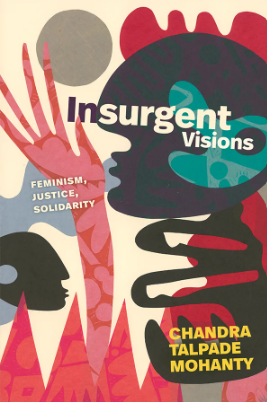 The activist-scholar, Chandra Talpade Mohanty, describes this book ‘as an evolving record, a document of my work on many fronts over the past two decades’ (1). The eight chapters (four co-authored) are organised in two equal parts: ‘Capitalist Scripts, Imperial Projects, Decolonizing Feminism’, and ‘Neoliberal Academic Landscapes, Transnational Feminisms, Cross-Border Solidarity’.
The underlying principle of Mohanty’s academic work and of her ‘insurgent feminist practice’ is her commitment to ‘the importance of the knowledge that emerges from the experiences of the marginalized groups that are engaged actively in struggles for justice’ (2). She focuses on ‘three geopolitical urgencies’: ‘(1) occupation, genocide, and Palestinian feminist struggles for justice; (2) the carceral state, abolition, and antiracist decolonizing feminist struggles in the United States; (3) Hindutva, Islamophobia, and caste resistance in India’ (9). These are set against ‘the rise of the global right’ and ‘strong men leaders’ (17), and ‘ideologies and practices of militarized masculinity, sexualized violence, and protectionist discourses of the nation’ (ibid.). The chapters contain ample examples of women’s resistance, organising, and alternatives to their oppression and exploitation, grounded in their respective perspectives and realities. Some of these examples will be familiar to many readers of this journal, others less so.
The book is an anthology of previously published chapters and journal articles (some dating as far back as 2010). Mohanty’s aim is to record the evolution of her thinking and practice, and few, if any, will have read all or even most of this collection. That said, had the book’s title indicated that it is a collection of her (often much earlier) works, it would have pre-empted irritation that some references to political leaders are very outdated, as are those to what are now historical rather than current events. But this is a minor quibble given that so many ‘strong men’ are still in power, some since the 2010s or even earlier; too many old men are clinging on to power, not least because more often than not they are enriching themselves and their families in the process. A case in point is that Donald Trump was re-elected, just shy of 80 years of age, despite being convicted on 34 felony charges of falsifying business records and found liable in a civil court for sexual abuse and defamation – indeed, boasting of his sexual entitlement in this regard. The three ‘urgent’ issues Mohanty identified have not been resolved but rather intensified – for instance, the United Nations Independent Commission of Inquiry on the Occupied Palestinian Territory, East Jerusalem, and Israel found that the Israeli authorities and security forces have, ‘since 7 October 2023, committed four of the five genocidal acts as defined in the Genocide Convention’;[1] the brinkmanship between India and Pakistan, both nuclear powers, regarding the region of Kashmir; and the assault in the US on citizens and foreign-born residents (documented or not) being snatched by masked ICE officials off the streets, and from their homes and workplaces, and bundled into vehicles with blacked-out windows, and then ‘disappeared’ – grimly reminiscent of the ‘dirty wars’ of the 1970s.
Each chapter contains more challenging insights than a brief review could possibly capture. For instance, that ‘gender is constitutive of economic and political structures of governance … gender ideologies and representations consolidate hierarchical relations of rule globally and … people’s identities are profoundly gendered’ (48); or ‘Women cannot be treated as a “special interest” group – economic gender justice and nonprivate service delivery systems are a core aspect of a broader anticapitalist struggle and a universal vision for equity and freedom’ (78). Mohanty maintains that ‘while attentive to issues of the intersectionality of gender, race, class, and sexuality … . just as US feminist scholarship has always been racialized and gendered, it has always encoded stories of North America as central to its knowledge production’ (152); but that also, the UN conferences on women (along with the environment, human rights, population and development, social development, and, I would add, international conventions on domestic workers, on social, economic and political rights, on disability, on the rights of the child, on Indigenous Peoples, on women’s reproductive and sexual health throughout the 1990s, and the Beijing +5 and subsequent reviews), have contributed to ‘the rise of transgendered movements, and the questioning of sex and gender as stable organizing categories for praxis’ (153). Chapter 6 (co-authored by M. Jacqui Alexander and published in 2010), ‘Cartographies of knowledge and power: transnational feminism as radical praxis’ argues that
distancing of sexuality from questions of transnational feminism, or rather the practice of deploying an uninterrogated heterosexuality to LGBTQ/queer studies … renders an incomplete story of the ways in which the racialized gendered practices of neo-imperial modernity are simultaneously sexualized. (173)
Since the chapter was written, various authors have addressed this very issue, bringing together international academics and practitioners from diverse disciplines and perspectives, especially from the Global South.[2]
Chapter 7, ‘Transnational feminist crossings: on neoliberalism and radical critique’ (published in 2013) makes for uncomfortable reading for anyone who has worked for or with relatively ‘gender-aware’ (international) non-government organisations (NGOs) and/or academic institutions and think tanks – as I myself have in various capacities for some 40 years. In my case, this includes a publication on deciding in Central America, where I worked throughout the 1980s, to come out as a ‘closet feminist’ (Eade 1991). Back then, left-wing men regarded ‘women’s strategic gender interests’ (pace Maxime Molyneaux) as at best a post-revolutionary optional extra, at worst a ‘bourgeois feminist’ distraction; a view not shared by emerging organisations of women peasant farmers, constantly accused of not adding to, but undermining, the existing male-run ‘authentic’ peasant associations; nor by women labour activists trying to unionise young women in the maquiladoras (assembly plants) that were springing up in northern Honduras and in Free Trade Zones across the region. These and other courageous women believed that unless social, economic, political, and cultural change, and the realisation of human rights, are deeply premised on the specific situations of poor, Indigenous, and hitherto ignored and voiceless women, any such efforts will be stillborn.
Highlighting ‘the need for systemic analyses’ and ‘the intellectual culture that is produced by this convergence [of depolitized neoliberal intellectual landscapes] in effect domesticates power differences, transforming systemic projects of resistance to commodified, private acts of rebellion’ (184), Mohanty cites another scholar’s insight (she is unstintingly generous in this regard) that ‘the neoliberal state relies on feminist NGOs for a theory of gender minus a feminist critique of power relations’ – something with which such NGOs might take issue. But it is harder to counter that ‘[T]he impact of women’s and gender studies programs in Europe has entailed a shift from a radical feminist critique to an emphasis on policy-oriented work that produces “equal opportunity experts”’ (195).
The conclusion, written while the COVID-19 pandemic was still rampant, ‘illustrates that borders cannot be shut down to keep the virus “out”’ (210), just as Trump’s first administration was fixated on building a ‘beautiful wall’ across the US southern border to keep out the migration ‘virus’.
Never mind that the southern US states were once part of Mexican territory, nor that current migrants are largely Latin Americans fleeing drug-related, political, or sexual violence, environmental catastrophe (repeated floods, chronic drought), living in grinding poverty, or just wishing to reunite with their family in the US – a country that for over a century had controlled and/or interfered in their countries’ economies and political choices. Regarding Latin America as its ‘back yard’ since the 1823 Monroe Doctrine, the US has a history of sponsoring state violence here, a dictatorship there (President Roosevelt allegedly saying in 1939 of the Nicaraguan dictator, Anastasio Somoza, ‘he may be a son of a bitch, but he’s our son of a bitch’) (see Funk 2011), conspiring to topple 14 foreign presidents from Chile to Grenada, and capturing three heads of state (Panama, Honduras, and now Venezuela to face trial in the US).[3] The consequences for human rights and the rule of law provide no constraint.
Now, in Trump’s second term, a flurry of executive orders have hobbled universities and independent agencies; imposed shifting and punitive tariffs on foreign economies whether major (the European Union and thus its 28 member states, Brazil, China, India – but not Russia), relatively minor (albeit not to the countries and workers concerned), or simply non-existent (two islands in Antarctica, inhabited solely by penguins!); seeks to muzzle the press and sue journalists, newspapers, and foreign broadcasters; openly discusses making Canada the 51st US state (referring to Mark Carney, the country’s current prime minister, as ‘a state governor’); and asserts the right to invade Greenland and appropriate its mineral resources, irrespective of the wishes of local populations. To say nothing of denying women’s right to control their fertility (the first edition of Our Bodies, Our Selves, published in 1970, is on my bookshelf, truly from another era) even when their own life is endangered. A pregnant child is, by definition, a rape victim, but might have to risk crossing state borders for a termination. In a macabre case in Georgia, where abortion is now illegal after six weeks, a brain-dead mother was kept alive for months so that doctors could deliver another orphan by caesarean section, after which the poor woman’s life-support machine was switched off, her role as a human incubator finally over (Sherman 2025).
To end on a more upbeat note, the final chapter also highlights the huge US demonstrations protesting against Elon Musk’s Trump-authorised evisceration of federal organisations, calling for
an end to ICE, for trans people’s liberation, for an end to genocide and justice for Palestine, for Indigenous rights, for women’s rights, for LBGTQ rights, for the freedom of Black and Brown peoples, for the freedom to think, create, teach, and organize inside and outside our schools and universities, for access to healthcare and reproductive rights, and for an end to gender violence and the violence of war and occupations around the globe. (215)
In other words, struggling to protect and deepen these rights encapsulates Mohanty’s ‘insurgent visions’ for justice and solidarity, and the capacity ‘to imagine, enact and own collective insurgent feminist futures’ (ibid.)
Notes
1 For the full text, see https://www.ohchr.org/en/press-releases/2025/09/israel-has-committed-genocide-gaza-strip-un-commission-finds.
2 See, for example, Harcourt (2013); Jolly et al. (2013); Cornwall et al. (2013).
3 Kinzer (2006). There have been further examples since the 14 cited in the book. See also Kinzer (2008).
© 2026 Deborah Eade