
City of Men: Masculinities and Everyday Morality on Public Transport
by Romit Chowdhury, New Brunswick, NJ: Rutgers University Press, 2023
Reviewed by Maya Krishnan
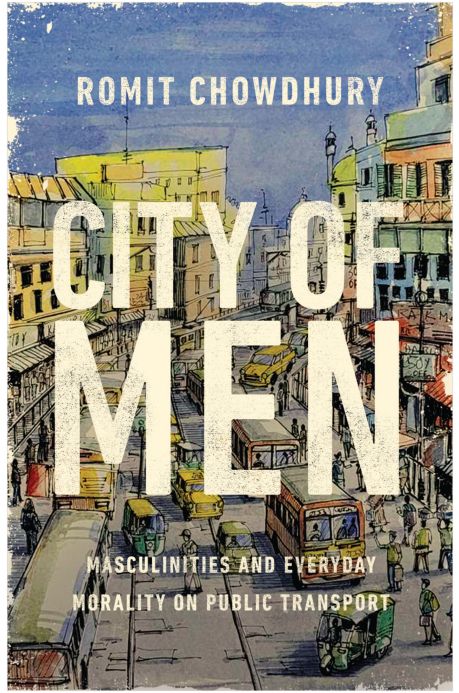 Urban India has been a popular and important site for ethnographic research on gender relations for decades. Vibrant, loud, colourful, often crowded, with India’s legacies of colonialism and independence, ongoing national and political debates, cultural variations, and linguistic diversity glimmering through, the Indian urban public provides every ethnographer with data everywhere they look. One element of Indian urban space that has been consistently conspicuous, and of interest to social scientists, and myself, as a woman ethnographer in India, is the dominance of men, spatially, as well as tacitly, in its material construction and in the public imagination of the city. Men can often be observed standing seemingly idle on the side of the road or conversing with other men for long hours at chai or food stalls, whereas women, when in public, are almost always seen with an evident purpose, labouring or on the move from one location to another. The ability to be at ease, leisure, or even to loiter in urban India is a highly gendered one.
As women have become increasingly significant participants in the formal workforce and in the rapidly shifting urban landscape, these observations have been well substantiated in feminist scholarship. They also form the opening for Romit Chowdhury’s City of Men, an ethnography of urban, working-class masculinities in Kolkata, the capital city of West Bengal (16). He demonstrates how heterosexual masculinities of transport workers in Kolkata, their daily negotiations and moralities, continuously structure urban Indian space as patriarchal.
Feminist scholarship on the gendered ordering of urban India has emphasised the effects of patriarchally structured space on harassment, discomfort, safety, and sexual violence in public. Chowdhury’s book, instead of highlighting these outcomes, brings together urbanisation and masculinity studies to investigate the processes of how working-class men inhabit and gender city spaces in ways that contribute to the gendered ability to exist safely in urban spaces. He also excavates a range of masculine insecurities, such as breadwinner ideology, driving competence, and neighbourhood knowledge, that structure their daily lives, and ultimately structure the patriarchy of the city. He conducts approximately 60 ‘go-along’ interviews with three groups of working-class male transit workers in Kolkata: auto-rickshaw drivers, taxi drivers, and traffic police (20–1). Building on prior sociological research on middle-class and consumer-centric masculinities in urban India, Chowdhury’s analysis instead focuses on gendered performances and masculine ideals of lower – and working-class men. His analysis demonstrates how middle-class imaginations of the ideal urban citizen vilify working-class men, particularly in constructing them as the principal threat to the safety of upwardly mobile middle-class urban women (9, 113).
The task at hand in Chowdhury’s book is a lofty one, conducting ‘a search for masculinities in city spaces and the influence of urbanisms on men’s lives’ (20). Chowdhury ties together a broader argument that resists the urge in urban studies to view urban social life as only preoccupied with violence and argues for an incorporation of pleasure, ‘braiding discord with collaboration’ (170). He ultimately argues that the city becomes normatively manufactured as a patriarchal space through both conflict and cooperation. Working-class men’s labour in the city conveys an urban narrative that brings together risk, trust, homosociality, and everyday moral deliberations. While male transit workers inevitably see each other as competitors, they simultaneously recognise common social motivations and expectations for men to be providers and important to their families’ survival, which in turn generates their own social worth (170). The ‘homosocial culture of trust’ generated from this mutual regard is what he argues has far-reaching consequences for the gendered and ultimately patriarchal ordering of the everyday city (122).
Chowdhury’s ethnographic vignettes, scattered throughout the middle chapters, which focus on auto-rickshaw drivers, taxi drivers, and traffic police, respectively, are detailed, captivating, and take the reader along for the ride. He demonstrates how hierarchical and hegemonic forms of masculinity create a constellation, rather than a monolith, of moral negotiations and motivations for working-class men. He weaves together vignettes and their analysis, explaining how various interactions and stories recounted by his interlocutors reveal gendered negotiations that not only exemplify both the conflict and collaboration required of urban sociality and life, but also how these public negotiations are intimately tied to broader traditional breadwinner masculinities derived from private life (169).
Auto-rickshaw drivers are cast as significantly more local and integrated into the urban landscape, who migrated to the city during earlier waves of migration or from West Bengal, particularly compared to taxi drivers who are primarily more recent migrants from Bihar. Auto-rickshaw drivers are bound to particular neighbourhoods or localities and can afford a level of comfort by working in areas they are familiar with, and know people and other auto drivers. In contrast, taxi drivers are not only migrants who may not speak Bengali, but also need to traverse the entire and often new or unfamiliar cityscape.
Chowdhury argues that transit workers exhibit different forms of masculinity. More local auto drivers choose not to drive at night, and only within known and familiar localities, performing sometimes ‘softer’ and ‘neighborhood masculinity’ (133). Bihari migrant taxi drivers may take more risks than auto-rickshaw drivers prefer to, including driving at night and to unknown areas of the city. Chowdhury argues that while both workers may be motivated by the desire to provide for their families, taxi drivers migrate from rural areas with very few employment opportunities and mobility both in their home state, and in Kolkata. They demonstrate a more aggressive masculinity, casting Bengali men as more effeminate (109). Despite the diversity of masculinities that Chowdhury documents, he also argues that the ‘provider ideology’ remains a consistent central thread and a common socio-moral lexicon. Chowdhury demonstrates how phrases such as ‘if your license is revoked for three months, how will you feed your family?’ (140) are commonly used by traffic police to incentivise safer driving and traffic rule-following, while similar rhetoric is attempted by transit workers to escape potential punishment for breaking traffic laws (128).
The chapters on localised Bengali auto-rickshaw drivers and Bihari migrant taxi drivers both include sections on their sexual lives. Chowdhury’s exploration of these aspects of their social lives and their relationship to masculinities, social motivations, and moralities is compellingly presented. He demonstrates throughout the book how common narratives among the urban middle class construct lower, working-class, and migrant men as the primary threat to public, particularly women’s, safety. Through exploring their sex lives and relation to their masculine identities, he demonstrates how the ‘everyday sexual conduct of poor migrant men sharply contradict[s] their representation in the middle-class imaginary as rapacious and the principal threat to middle-class women’s safety in the city’ (113). He goes on to emphasise how middle-class men’s own contribution to urban risk and danger to middle-class women often goes overlooked in mainstream discourses around urban safety.
Chowdhury’s broad critiques of middle-class narratives around ideal urban citizenship, risk, and safety are well taken. He also presents an analysis of lower-class masculine identities and daily negotiations, which have been sorely missing from the study of masculinity in urban India.
However, Chowdhury’s focus on class differentiations in urban masculinities is crucially missing engagement with the intersection of caste identity. His focus on working-class masculinities and interrogation of a hierarchy of ideal masculinities in urban India necessitates an interrogation of how Brahmanical patriarchy has contributed to these ideals in Kolkata. There are scant references to caste throughout the book; the only significant discussion comes in the conclusion, where he mentions a ‘Brahmanical system of thought’, slipping into an explanation of householder-centric masculine morality and the moral economy of Hindu society without further explanation or analysis (164). Caste identity and how it interacts with masculinity are neglected throughout Chowdhury’s analysis and would be particularly beneficial in explaining instances of conflict versus collaboration for transit workers. Specifically, Chowdhury relies on the supposed ‘respectability’ of some gender identities, such as sisters, mothers, and children, and interactions in daily life, and how caste may influence how some women are afforded differential respectability in these interactions (70).
In India, where ideals of masculinity are intimately constructed alongside ideals of caste, as well as class identities, such a thin incorporation of caste identity and its regional politics in Kolkata weakens Chowdhury’s overall argument and analysis. Additionally, while Chowdhury mentions several instances where Muslim neighbourhoods and patrons of hired transport are subject to anti-Muslim stereotypes of crime and danger, he fails to connect these instances in his ethnographic data to the increasing idealisation of Hindu masculinity with patriarchal structures and space in India. Chowdhury’s discussion of purity and pollution, key to both gender and caste inequities, is minimal and exclusive to a few vignettes relating to transport workers’ sexual lives in the city (114–15). Taken together, his interrogation of what incentivises householder, breadwinner, or provider-centric forms of masculinity is missing both the Hindu-centric and caste-based key elements of idealised Indian masculine identities and how they emerge across the class spectrum.
Chowdhury’s argument ultimately casts the urban space as unequivocally masculine and patriarchal. However, a more accurate representation of urban mobility in India may be to claim that the city is increasingly contested based on gender, which could actually further support his argument around conflict and collaboration as simultaneous forces. For example, earlier this year, the city of Chennai in Tamil Nadu launched 100 pink auto-rickshaws with exclusively women drivers. Pink autos have been an element of the Indian urban landscape since as early as 2013, with a number of NGOs consistently working to integrate women drivers in the transit industry across urban India (The Hindu 2025; Vardhan and Mahato 2019). The urban space is indeed still dangerous for many city-dwellers, particularly women who are often alienated from leisurely existence in the urban public. However, as evidenced by Chowdhury’s analysis, urban space in India, particularly global cities like Kolkata, is one of dynamic change, and women are continuing to enter and remain in the public sphere. Male homosocial urban culture, which ‘gives life to an interpretive framework that reads women’s presence in the outdoors as an anomaly’, is not monolithic, similar to the masculinities that homosocial culture is composed of (171). Rather than characterising the urban public and broader cityscape as unequivocally patriarchal, it may ultimately be more accurate to describe it as consistently contested, particularly through the urban sociability of collaboration/conflict and an evolving interaction of ‘homosocial trust’ with the urban landscape.
I found Chowdhury’s methodology relatively thin. He provided limited information on the duration of interviews or the extent to which his participants were fully informed about his research and were able to consent to participation in the project. Beyond stating his identity as someone who has lived in Kolkata for 26 years, he did not provide much information on his own positionality, or reflexive analysis, a key element of conducting ethnography, particularly within or on marginalised and working-class communities. There was limited interrogation of his class, caste, or social status positioning relative to his interlocutor service workers who were simultaneously working. An ethnographer’s presence in their field of research inevitably alters it, particularly when there are obvious differences in social status that may alter the power dynamics of the field and how interlocutors may respond to the ethnographer. These would have been interesting and important ethical deliberations to include in how he engaged in this research, as well as provided thicker descriptions and evidence of how interlocutors interacted with him and in the field.
Ultimately, Chowdhury’s work provides key contributions to the broader study of masculinity in urban India, particularly via his focus on working-class and migrant masculinities, adding a critical dimension to prior research on middle-class, consumer-centric masculinities in urban India. Moreover, the broader argument brings together collaboration and conflict, rather than the previous emphasis on conflict and violence in urban sociality. He presents a necessary critique of the consistent urban middle-class impulse to blame the lower and working classes for every perceived urban problem, from city traffic to sexual violence against women in public spaces, using them as a scapegoat to support broader imaginaries of idealised urban citizenship.
References
- The Hindu Bureau (2025, August 25) ‘Rotary members handover 100 pink autorickshaws to women’. https://www.thehindu.com/news/cities/chennai/rotary-members-handover-100-pink-autorickshaws-to-women/article69974470.ece(open in a new window) (accessed 23 November 2025)
- Vardhan, Julie and Madhuri Mahato (2019) ‘A tale of determination and grit: The success of pink autos’, South Asian Journal of Business and Management Cases 8(2): 137–145
© 2026 Maya Krishnan