
Dalit Feminist Discourse: Voices in Dalit Writings
Edited by Charu Arya and Nabanita Deka, New Delhi: Aakar Books, 2024
Reviewed by Malavika Priyadarshini Rao
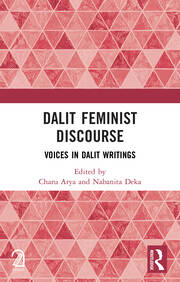
Charu Arya and Nabanita Deka’s edited volume, Dalit Feminist Discourse: Voices in Dalit Writings, makes an undisputable and ethical enquiry into the thrice alienated existence of Dalit women. The text untangles the visceral knot of caste, class, and gender that defines this marginalisation. As Raj Kumar’s Foreword incisively frames it, ‘Dalit women are referred to as “Dalits among the Dalits” or “downtrodden among the downtrodden” because they are thrice alienated on the basis of their class (poor), caste (outcaste) and gender’ (7). Through minor literature (a mode where marginalised groups subvert a dominant language to voice their specific struggles) and resistance poetry, the editors of this volume trace the affective worlds and narrative strategies birthing Dalit feminist expressions, amplifying the Neo-Dalit women who defy oppressors (13–20). The introduction pulses with this imperative, forging new Dalit women identities through education’s radical promise, echoing reformers like Ambedkar and Phule who saw knowledge as annihilation’s forge (18–20). The volume’s primary concern revolves around the Dalit female body, masculinisation of Dalithood, the erasure of women’s voices within the movement, and Dalit women’s negotiations of caste and patriarchy’s brutal nexus. These themes unfold via literary interventions, sociological reflections, and theoretical frameworks from Bengali, Tamil, Malayalam, and Hindi vernaculars, thematically crafted into three parts: gendered subalternity’s reframing (Part I, 37–109), resistance poetry’s manifesto (Part II, 111–60), and the aesthetics of the Dalit feminine self (Part III, 161–223). Contributors weave together a diverse array of topics, ranging from the ambivalence of education in the transnational caste experience to Church complicity in maintaining caste hierarchies and the nuances of diasporic concealments. This ambivalence refers to education’s role as a tool for radical social mobility and the reality of academia as a site of institutional cruelty, where epistemologies are often silenced through biased hiring and everyday microaggression. These varied perspectives coalesce into a cohesive argument for a distinct Dalit Feminist Standpoint, an analytical framework that centres the unique intersection of caste and gender. The volume is accessible yet theoretically dense, providing a rigorous collective critique that serves as a vital articulation of survival.
Theoretical and poetic currents: bodies as archives, voices as insurgents
The volume begins with Anne Placid and Binu K.D. provoking a dismantling of dominant feminisms’ strategic denial of agency to Dalit women’s precarious bodies (Chapter 1, 37). Drawing from Black feminism’s cues, yet rooted in India’s caste terrain, they expose mainstream feminism’s elitist ignorance – class privileged voices claiming universal womanhood, while eliding Dalit precarity. This threads seamlessly into Ashutosh K. Prabhakar’s Listen to My Body!, where the body emerges not as mere biology but as a generational archive of humiliation, sedimented across the caste disciplining gaze (52–60). Reclamation here is a radical gesture: refusal of docility, and a corporeal uprising against the oppressor’s stare that renders Dalit flesh both as indispensable labour and ritual abject.
Deepthi Menon carries this enquiry forward, by charting minor literature’s insurgent aesthetics – Dalit narratives as subversive circuits that unsettle and de-territorialise dominant linguistic order (61–74). Pratibha Singh confronts the Dalit movements’ silences on Dalithood’s masculinisation, unmasking a disquieting truth: Dalit men’s liberation offers no sanctuary for women. Violence against Dalit women operates as a systemic device – precise, patterned, instrumental in sustaining caste hierarchy (Chapter 5, 75–83). Singh destabilises the fiction of an undifferentiated female subject, exposing gendered fault lines: annihilation of caste shadowed by women’s marginalisation, their voices muffled even in resistance’s chorus.
Part II turns to poetry’s manifesto. Shuvani Sengupta unveils Aruna Gogulamanda’s charged imagery: Dalit women’s body rendered necessary yet abject – indispensable to social labour, cast aside with ritualised disdain (135–46). Neelima B. echoes this in her examination of S. Joseph’s verses, where the male gaze hovers between empathy and erasure, unsettled by female subjects asserting autonomous subjectivity (Chapter 10, 147–57). These readings amplify the Foreword’s articulation of being thrice alienated (7–9); poetry becoming breathwork against erasure, a rhythmic refusal of invisibility.
Prose and diasporic echoes: unsettling masculinities, archiving the unsaid
Brati Biswas (Chapter 11) probes Jatin Bala’s fiction, revealing educated Dalit women as disruptors: their intellectual autonomy ignites anxiety in Dalit men who fear loss of control, unsettling entrenched masculinities (161–9). Lakshmi R. Nair extends to the diaspora as she analyses Yashica Dutt’s memoir: ‘hiding her caste becomes imperative in these transcultural spaces for fear of discrimination’ (181–92). A concealment born of transnational caste’s persistence, where visibility invites violence.
Arunabha Bose reads Bama’s Vanmam as an archive of the unsaid, distinguishing rigid scaffolding of formal historicity from the fluid, breathing historicality of collective memory (193–214). In this context, Bose uses historicality to describe history as a lived, ongoing experience preserved through rumour and fractured recollection rather than a static list of past dates and events. In Bama’s hands, rumour and fractured recollection morph from distortions to truth vessels – knowledge inscribed on untouchable bodies, irreducible to ethnographic distance. ‘To mark time’, Bose observes, risks relegating caste violence to a completed past; Bama counters this by voicing the irreducible (193–214). Yanpolumi M. Sangma’s concluding chapter on Karukku underscores Church complicity in caste hierarchies, layering Dalit Christian women’s subjugations: conversion no shield against gendered caste’s grid (215–23). These prose interventions vitalise Part III; aesthetics of Dalit feminine self-emerging as endurance’s form, resistance etched in narrative flesh.
Limitations as productive fault lines: toward nuanced reckonings
The anthology is not without its limitations, yet these fault lines provoke rather than diminish. The recurring claim in Chapter 12 – education as a primary remedy for caste oppression – rings true in Ambedkarite lineage. However, it arguably evades academia’s institutional cruelties: biased hiring, curricula that silences Dalit epistemologies, and microaggressions in hallowed halls. I would like to suggest that addressing these gaps requires more radical alternatives. These might include policy-driven affirmative action within academic hiring and research, ensuring Dalit representation in how knowledge is produced, or community-led pedagogical reforms that decolonise syllabi from Brahmanical influences.
Despite the volume’s analytical depth, its primary focus on literary analysis lacks immediacy of direct ethnographic engagement. While the Foreword invokes the presence of rural Dalit women, their experiences remain mediated through textual interpretation rather than being present as first-hand, embodied accounts (7–9). The absence of integrated fieldwork, such as oral histories or participatory ethnographies, represents a notable gap in the collection. Such an approach would have grounded the book’s theoretical abstractions in lived precarity, effectively bridging the distance between urban academic gaze and the rural realities where being thrice alienated is most acutely experienced (7–9). Dalit patriarchy’s urgent critique risks one-sidedness: foregrounding the Dalit man as oppressor overlooks caste’s psychic toll on family units. Systemic emasculation – upper-caste immiseration rendering Dalit men ‘lesser’ in labour markets; psychic wounds manifesting as internalised violence – demands intersectional nuance. A fuller dialectic would trace how oppression rebounds within, fostering cycles that no single lens can sufficiently shatter.
Dalit Feminist Discourse ruminates caste-gender entanglements with a theoretical density that remains an accessible critique of endurance and a visceral articulation of survival. Ultimately, the volume successfully achieves its goal of constructing a rigorous Dalit feminist standpoint epistemology. It effectively echoes Ambedkar’s call for caste annihilation, Phule’s educational fire, and Savitribai’s radical poetry to awaken the oppressed. While the volume could have been further strengthened by direct ethnographic engagement with rural subjects, it remains a vital contribution to the field. This book is highly recommended for students and scholars of Dalit studies, gender studies, and South Asian sociology, as well as activists seeking to understand the intersectional mechanics of Brahmanical patriarchy. In the shadow of triple alienation, it forges a path for empowered Dalit resistance: bodies reclaimed, voices amplified, a manifesto for futures where Dalit women breathe untrammelled.
© 2026 Malavika Priyadarshini Rao