
Depletion: The Human Costs of Caring
by Shirin Rai, Oxford: Oxford University Press, 2024
Reviewed by Shivani Satija
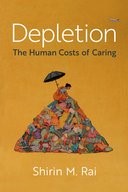 Depletion: The Human Costs of Caring by Shirin Rai was written during the pandemic, a crisis that revealed the cracks in already-inadequate social infrastructures and the commercialisation and privatisation of care across the world. This crisis was in the making for a long time through a series of austerity measures, erosion of public service provision, growing state neglect, and deepening climate crisis, all of which compounded the marginalisation of Black, Indigenous, and Dalit women. A product of ten years of labour, this book is based on a 2014 paper that Rai co-wrote with Catherine Hoskyns and Dania Thomas in which they conceptualised depletion as harm. They explain, ‘depletion as harm occurs when there is a measurable deterioration in the health and well-being of individuals and in the sustainability of households and communities’ (Rai, Hoskyns, and Thomas 2024, 91).
This book is situated among recent scholarship on the feminist political economy of care; namely The Care Manifesto: The Politics of Interdependence by the Care Collective (2020), Care and Capitalism: Why Affective Equality Matters for Social Justice by Kathleen Lynch (2022), and Cannibal Capitalism: How Our System is Devouring Democracy, Care and the Planet – and What We Can Do About It by Nancy Fraser (2022). It advances these academic discussions through a much-needed inter-sectional and inter-generational analysis of the silent (silenced) side of care labour across the global South and North; a silence that reverberates in the utterly exhausted bodies, minds, dreams, and desires of women, and often children who perform this relentless labour, day in and day out. More recently, Vincent Guermond, Katherine Brickell, and Nithya Natarajan’s 2025 article in Antipode deployed depletion through social reproduction in inter-disciplinary contexts. Others like Jayanthi Thiyaga Lingham and Melissa Johnston (2025)[1] and Vincent Guermond et al. (2025) mobilise this concept in the context of war and conflict in Sri Lanka and Myanmar, and climate crises and debt in Cambodia, respectively.
Revealing the hidden costs of care
Rai’s book addresses the unseen and deliberately hidden costs of care labour – a form of labour that is gendered, racialised, even dehumanised, and by default relegated to the realm of the ‘natural’ and ‘feminine’. She offers a theoretical, political, and methodological analysis of depletion as harm at the level of the individual, household, and community. She urges readers to recognise the cost of care labour and bring visibility to the bodies that perform it. Through in-depth empirical work in India, the UK, and South Africa, she reveals the disproportionate burden of care labour that Black, Dalit, and Indigenous women, as well as children and young people, perform and experience every day, and on whose backs the capitalist and extractive relations of production are built and sustained. The ‘institutionalised denial’ of care as work is most evidenced in its near absence or under-representation in most countries’ GDPs, national budgets, and labour policies. Thus, care labour, both paid and unpaid, that ‘maintain the rhythms of life-ecology do not count in/as production’ (p. 2).
Structure of the book
The book is structured along six chapters that address invisible, inter-sectional, and inter-generational dimensions of care work, depletion, and its harms. The introductory chapter lays down the historical and conceptual terrain, which equips the reader to navigate the chapters that follow. It provides definitional clarity of key terms such as ‘care work’ as relational and normative; social reproduction as structural which ensures the daily and generational tasks that sustain capitalist systems; and depletion along with its historic, present, and anticipatory harms and discussions to reverse these.
The first chapter ‘Depletion, Harms and Struggles to Reverse Them’, draws from a wealth of inter-disciplinary scholarship to acknowledge the ‘non-recognition’ of social relations of care by the state and capital. This adds to depletion and undermines any possibility of attaining gender justice. Rai states, ‘Making depletion visible would provide strong evidence for the necessity of recognising the subsidy that social reproduction pays to global capital and to addressing the human costs of this subsidy’ (p. 31). The concept of depletion is thus introduced as a diagnostic tool to reveal and expose the gendered and racialised costs of social reproduction, as well as the capitalist regimes of exploitation, extraction, and dispossession.
The second chapter, ‘Measuring Depletion’, is a methodological discussion that calls to measure depletion in order to devise strategies to reverse it. It unveils the colonial and gendered biases implicit within ‘numericalised norms’ that produce certain kinds of realities, categories, and interpretations and shape policy. Rai urges us to regard methodology as political, which is often adjusted to either afford or deny recognition to certain people or processes. Through regimes of measurement, non-recognition of care work is legitimised which is integral to capitalist relations of production.
Drawing from time-use survey methodology and other measures of well-being and environmental accounts, Rai and True developed the Feminist Everyday Observation Tool (FEOT) which Rai employs in this book to capture ‘the textures and rhythms of everyday life/work and their effects and how subjectivities are framed through this work, which in turn affect our sense of self’ (p. 72). Together, the researcher and participants map the everyday and discuss the emotions around the work – what brings them joy, what they do for leisure, how they navigate despair, and how they restore their energies.
Chapter Three, ‘A Day in the Life of … Mapping Individual Depletion Across Class Boundaries’, traces the lives of eight women in Delhi, occupying diverse socioeconomic positions, but each bearing the weight and drudgery of everyday paid and/or unpaid care labour. Through detailed interactions, reflections, and time-use records, stories are revealed about how women straddle the realms of work, home, rest, and leisure. The sense of depletion, leisure, and rest is differentially experienced across class and caste as well as shaped by the lack of supportive state policies/infrastructures. Women with means are able to outsource care work and allow inflow of leisure and rest time thereby mitigating depletion: ‘Depletion gets passed down the labour chain’ (p. 101). However, the sense of ‘physical exhaustion and mental and emotional fatigue is a thread that ties together these narratives’ along with the desire to have their work recognised, shared and respected (p. 100). The stories were of these individuals, but also involved the labour of other women (family or paid), thus revealing that ‘social reproduction is built into the social economy of individuals, households and communities’ (p. 86).
The fourth chapter, ‘Depletion on the Move – Commuting and Social Reproduction’, explores the ‘liminal labour’ of women as they traverse the space and time between production and social reproduction. Commuting for work and care both can cause depletion of money, time, and energy but is considered completely outside any labour calculations. It needs to be recognised to reshape mobility infrastructures and norms along inclusive and democratic principles. Dalit and racialised women are worse off because they often live in segregated places that are located far from their workplace or in impoverished neighbourhoods closer to work. Transport infrastructure (or lack thereof) affects poor women disproportionately, with many having to walk large distances or navigate unsafe paths to reach work. Commuting also requires women to often multi-task while on the move, take multiple modes of transport, and then walk the last mile. Yet, commuting also offers a space for some women to socialise, network, and partake in leisurely activities like reading and listening to music.
Chapter Five, ‘Depleting Futures – Children Who Care’, brings much needed attention to the inter-generational dimension of care and the harm it causes through the depletion of childhoods. Focusing on interviews with children between the ages of 8 and 16 years in 24 households in Coventry, UK, Rai unpacks the complexity of this kind of care labour. Children who do care work experience not only a lack of recognition of work and pay, but also stigma in legal and social relations. They have to navigate the pulls and tensions of familial responsibilities, love, and duty, along with their desire to spend time with friends and generally enjoy themselves. As Rai explains, ‘Here is the conundrum: care work is not counted as work for adults, and it is seen as problematic for children, who are socially constructed and normatively framed as minors who need to play and study; they need protection’ (p. 168). While the role of non-state organisations like YCS, an NGO that works to support child carers, is critical in supporting children who care, the lack of state support is stark. For effective and sensitive policy to be framed, the notion of care and childhood needs to be deconstructed and decolonised, and the spillover between work, play, and care needs to be carefully understood.
The sixth chapter takes the reader to the future, where depletion is imminent. ‘Postcards to the Future: Anticipatory Harms and Struggles Against Extractivism’ addresses depletion waiting to happen through the eyes of the Xolobeni community (Amadiba) in Eastern Cape, South Africa who are witnessing their land, lives, and history being gradually extracted, eroded, and erased by mining industries in collusion with the state. This kind of violence is structural and slow and ‘invokes everyday dystopias’ (p. 170). Rai draws from a visual archive curated by Pierce (2018), which captures the collective angst and resilience of the Amadiba in the form of postcards written to mine owners and state officials. Their political and legal mobilisations against the mining company and the state adds to their everyday social reproductive work which is already gendered. ‘Worry takes political forms and cultural resistances’ (p. 1), and the wait to be recognised and heard adds to the depletion of the community. The community is actively carving a solidarity politics based on holding the state accountable, and mitigating, replenishing, and transforming social relations grounded in the political and historical narratives and imaginaries of South Africa (p. 171). Their mobilisations expose the intimate link between the human and ecological worlds and show how ‘the struggles to reverse depletion and destruction of alternative modes of living are inextricably linked’ (p. 171).
Carving a regenerative politics based on rest, healing, and resistances
Rai concludes by reiterating the need for state and non-state actors to go beyond mitigatory and replenishing strategies of harm, which are limited to being individualised and marketised, and move towards transforming the current modes of social reproduction based on extraction and invisibilisation. ‘We need a politics of a regenerative state that is redistributive and replenishing and supports social infrastructure that might replenish those who are depleted’ (Rai, True, and Tanyag cited on p. 204). She calls for the nurturing of reflexive solidarities and activisms that demand an alternative mode of living based on caring for human and ecological worlds.
Shirin Rai’s book offers a robust conceptualisation and measure of depletion as harm embedded in rich field insights, which would be immensely useful for research and policy. A deeper analysis of the relationship between caste and migration, and depletion would have been ideal. This book will be useful for scholars and practitioners who want to gain a deeper understanding of the political economy of care and the inter-sectional implications of care work from multiple disciplinary perspectives.
[1] This was discussed by Shirin Rai in a seminar organised by the Department of Social Policy and Intervention Oxford in 2025.
References
Fraser, Nancy (2022) Cannibal Capitalism: How Our System is Devouring Democracy, Care and the Planet- and What We Can do About It, London, UK: UK Verso Books.
Guermond, Vincent, Katherine Brickell, and Nithya Natarajan (2025) ‘Replenishing geographical thinking on depletion through and of social reproduction’, Antipode 57: 459–470. https://doi.org/10.1111/anti.13116.906
Guermond, Vincent, Dalia Iskander, Sébastien Michiels, Katherine Brickell, Gráinne Fay, Long Ly Vouch, Nithya Natarajan, Laurie Parsons, Fiorella Picchioni, and W. Nathan Green (2025) ‘Depleted by debt: “green” microfinance, over-indebtedness, and social reproduction in climate-vulnerable Cambodia’, Antipode 57: 471–493. https://doi.org/10.1111/anti.12969.
Lingham, Jyanthi Thingya, and Melissa Johnston (2025) ‘Running on empty: depletion and social reproduction in Myanmar and Sri Lanka’, Antipode 57: 494–514. https://doi.org/10.1111/anti.13016.
Lynch, Kathleen (2022) Care and Capitalism: Why Affective Equality Matters for Social Justice, Cambridge, UK: UKPolity Press.Perce, Thom (2018) “Postcards from Xolobeni”. Daily Maverick. April 20. https://www.dailymaverick.co.za/article/2018-04-20-postcards-from-xolobeni/ (accessed on 22 October 2025).
Rai, Shirin, M. Catherine Hoskyns, and Dania Thomas (2014) ‘Depletion: the cost of social reproduction’, International Feminist Journal of Politics 16(1): 86–105. https://doi.org/10.1080/14616742.2013.789641.
The Care Collective, Andreas Chatzidakis, Jamie Hakim, Jo Litter, and Catherine Rottenberg, (2020). The CareManifesto: The Politics of Interdependence. London and New York: Verso Books.
© Shivani Satija