
Women and the UN: A New History of Women’s International Human Rights
Edited by Rebecca Adami and Dan Plesch, Abingdon, UK and New York: Routledge, 2021
Reviewed by Deniz Alca
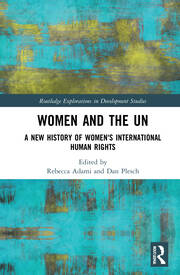 In the wake of the 30th anniversary of the Beijing Declaration and Platform for Action, questions of feminist memory have become even more urgent. Beyond evaluating progress or shortfalls, there is now a pressing need to ask whose contributions are remembered, and whose struggles remain obscured. Women and the UN: A New History of Women’s International Human Rights, edited by Rebecca Adami and Dan Plesch, positions itself not as a commemorative exercise but as a deliberate intervention into the politics of memory. Organised as a collection of contributions from multiple authors, the volume combines a broadly chronological sequence with thematic approaches: different chapters examine pivotal United Nations (UN) events and conferences while also engaging cross-cutting issues to reconstruct neglected struggles and actors. From the opening pages, the volume challenges sanitised histories. In her Introductory Note, Torild Skard reminds us that ‘accounts of women’s activities and achievements in the past as well as the present were extremely rare’ (p. xv). She recalls the 1945 San Francisco Conference, where Latin American feminists Bertha Lutz and Minerva Bernardino had to fight for the explicit inclusion of ‘women’ in the UN Charter, against resistance from Anglo-American delegates. This moment underscores how the struggle for women’s rights at the UN was never straightforward, and how fractures between North and South were present from the very beginning.
The preface by Fatima Sator and Elise Dietrichson deepens this critique. They point out that the absence of figures like Lutz in official UN narratives is not accidental but part of a wider pattern of erasure: ‘a wider tendency neglecting the contributions of women in international relations, and particularly … fundamental Southern contributions to global norms’ (p. xxi). Fatima Sator and Elise Dietrichson’s historical recovery is not only academic but also political; reminding us that feminist historiography itself can be a form of activism.
Several chapters illustrate how women from the global South decisively shaped international legal texts. Khushi Singh Rathore documents Hansa Mehta’s revision of Article 1 of the Universal Declaration of Human Rights, changing ‘all men’ to ‘all human beings’ (p. 45). This intervention was grounded in Indian women’s anti-colonial and feminist struggles, showing how the language of universality was itself a contested terrain. Similarly, Ellen Chesler highlights the pivotal roles of Annie Jiagge (Ghana) and Leticia Shahani (Philippines) in the drafting of the 1967 Declaration on the Elimination of Discrimination Against Women and the 1979 Convention on the Elimination of All Forms of Discrimination Against Women (CEDAW). These chapters disrupt the assumption that human rights law was written for, rather than by, women of the global South.
Other contributions explore how women used the UN’s bureaucratic machinery to pursue social and economic rights. Rebecca Adami’s chapter on the 1949 Beirut session of the Commission on the Status of Women shows how Lakshmi Menon, Minerva Bernardino, and Emilie Fares Ibrahim advanced demands such as equal pay and childcare, even in the face of opposition from powerful Western delegates. Rather than framing the UN as irredeemably patriarchal, the editors describe it as a ‘negotiated space’ (p. 162) – a contested arena where feminist actors have won important, if partial, gains. Taken together, these contributions demonstrate how bureaucratic engagement was itself a feminist practice – an attempt to utilise institutional mechanisms both as platforms for resistance and as spaces for norm creation.
The book does not shy away from exposing silences and limits. Linde Lindkvist asks whether children’s rights were ever a feminist project, concluding that despite clear connections to caregiving and family structures, they were rarely central in UN gender debates. Roland Burke examines how early UN discussions on practices like child marriage or ‘honour-based’ violence failed to conceptualise these as systemic human rights violations, relegating them to the sphere of culture.
This dynamic is particularly visible in the book’s treatment of soft law, which are non-binding instruments that nonetheless shape international norms and policies. Aoife O’Donoghue and Adam Rowe interpret the 1975 Mexico City Conference not as a consensus but as a rupture, where Southern delegates foregrounded economic justice, sovereignty, and anti-imperialism. The resulting Declaration of Mexico and World Plan of Action were non-binding, yet they institutionalised feminist soft law by linking gender to global inequality. This framework sets the stage for Cornelia Weiss’s analysis of UN Security Council Resolution 1325, where the achievements of bringing gender into the Security Council’s remit also reveal the fragility and limits of soft law.
Cornelia Weiss’s chapter on UN Security Council Resolution 1325 offers both recognition and warning: while the resolution brought gender into the heart of peace and security debates, its implementation has been uneven, haunted by the ‘ghosts of women who shaped the Resolution’ but were left out of official accounts (p. 158).
Taken together, these contributions make a compelling case for reframing feminist diplomacy as a project of memory as much as policy. The book demonstrates that agency from the global South has always been central, even if rarely acknowledged in dominant histories. By excavating these hidden contributions, the volume contests what the editors call a ‘restorative archaeology of knowledge’ (pp. 162–5), pushing us to see the UN not simply as a stage where women demanded rights, but also as an institution actively shaped by women’s struggles across regions.
For today’s debates, especially in the aftermath of Beijing+30, the book carries important lessons. It reminds us that feminist victories at the UN were never gifts from above but outcomes of persistent contestation. It also warns us against complacency: the erasure of women’s agency is ongoing, and remembering differently is itself a political act. As Skard and others show, the past reveals both achievements and obstacles – bureaucratic resistance, geopolitical divides, and patriarchal backlash – that remain relevant today.
The relevance of Women and the UN for contemporary feminist diplomacy lies in its fusion of historical recovery with political urgency. The book dismantles ‘beneficiary’ narratives that cast global South women as recipients rather than authors of human rights, offering instead a genealogy of norm entrepreneurship from the margins. This emphasis on agency resonates with broader feminist scholarship outside the volume. It is a call to reclaim forgotten genealogies of feminist diplomacy and to centre non-Western agency in the narratives we carry forward. For readers marking Beijing+30, it offers both inspiration and challenge: inspiration in the stories of women who defied structures to reshape global norms, and challenge in recognising that this work is far from finished. By combining historical recovery with political urgency, the volume offers a roadmap for a feminist future grounded in a fuller, more-inclusive memory of the past. The editors describe this as a deliberate excavation of neglected histories that restores silenced voices to the international record. This archaeology is not about nostalgia but about equipping contemporary struggles with deeper foundations. It reminds us that the UN’s feminist past is not simply commemorative – it is constitutive of how we imagine feminist futures.
This political and historical intervention is further reinforced by the book’s style and structure, which make its arguments widely accessible without sacrificing scholarly depth. Women and the UN: A New History of Women’s International Human Rights is firmly grounded in archival research and critical scholarship, yet written in a style that is clear, engaging, and accessible. Without assuming prior expertise in feminist theory or international law, the volume makes complex debates readable for generalist audiences while still offering original insights for scholars and practitioners. Its structure and language avoid unnecessary jargon, instead foregrounding concrete historical narratives and sharp political analysis. This makes the book a valuable resource for a wide readership: from students and academics in international relations, human rights, and gender studies, to development practitioners, multilateral policymakers, and feminist activists. More than a corrective to institutional memory, the book offers a practical framework for understanding how feminist actors have historically engaged multilateral systems – not only to critique them, but to reshape them from within. It will resonate with anyone interested in power, accountability, and the politics of transformation at the global level.
© Deniz Alca